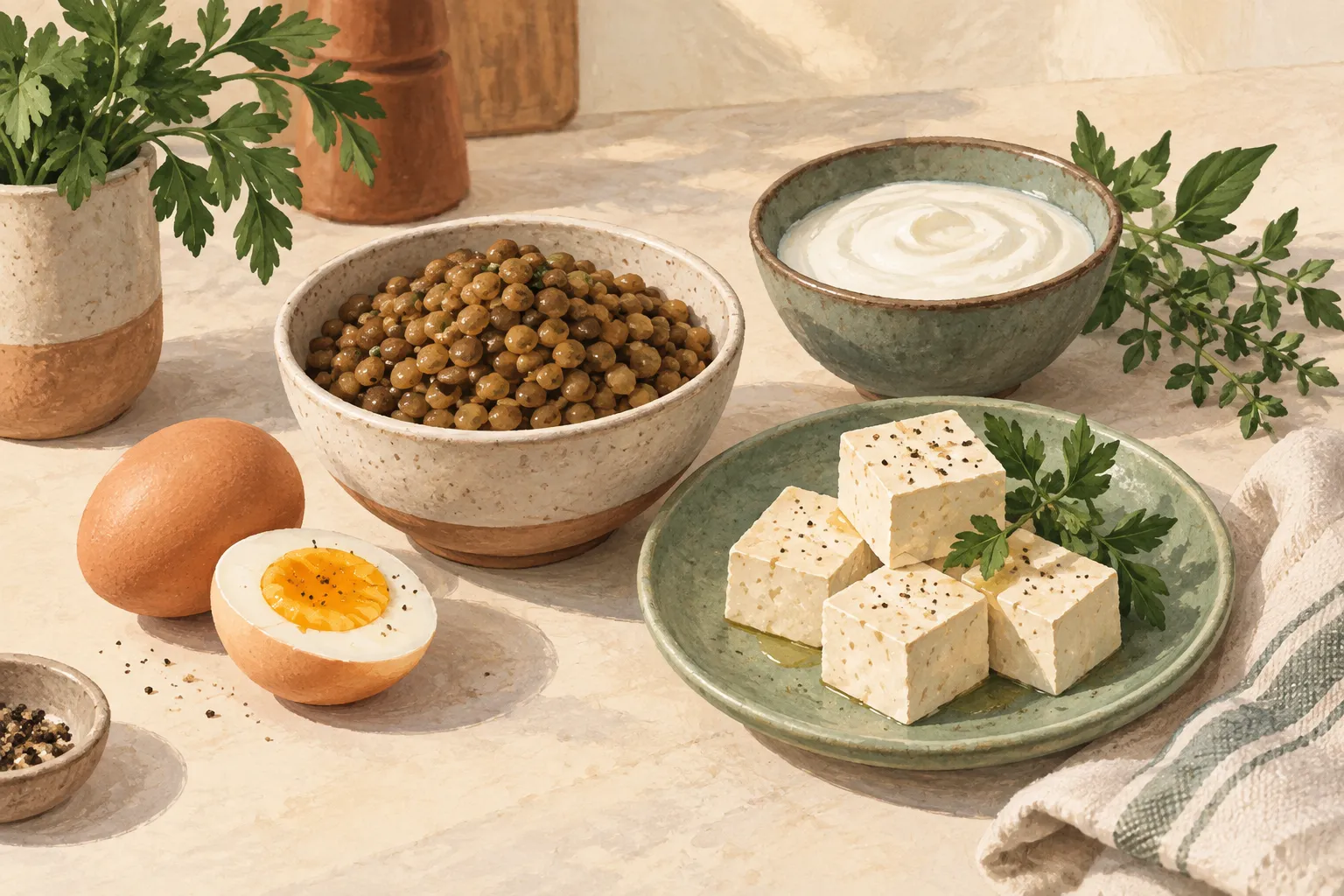
Protein matters during weight loss for two separate reasons: it can make meals more satisfying, and it can help limit the loss of lean tissue as you lose weight. Neither benefit requires treating protein as a miracle ingredient.
Protein matters during weight loss for two separate reasons: it can make meals more satisfying, and it can help limit the loss of lean tissue as you lose weight. Neither benefit requires treating protein as a miracle ingredient.123
Understanding what makes us hungry leads naturally to a practical question: what can we change about a meal to make it more satisfying? Protein is one part of that answer. But “eat more protein” is only useful advice when you understand what it does, what it cannot do, and how to fit it into food you actually enjoy.
Protein is not just for people who lift weights
Your body breaks dietary protein down into amino acids, which it uses to build and repair its own proteins. These are part of cells and tissues throughout your body—not just the muscles you can see. Some amino acids must come from food because your body cannot make them.4
That makes adequate protein a basic nutritional need, whether or not you exercise. During weight loss, there is an additional reason to pay attention: the weight you lose is not necessarily all body fat.43
It helps to separate those two ideas. Meeting a nutritional need is not the same as finding the largest possible protein target. More is not automatically the goal.
How protein can help with hunger
Satiety is the feeling of being satisfied after eating. Protein can contribute to it. A 2020 systematic review and meta-analysis of randomized trials found that higher-protein conditions reduced hunger and increased fullness, on average, in short-term comparisons with the same calorie content.5
That last detail matters: the difference was not simply that participants had been given more calories. Meal composition can change the experience of eating, even when the energy content is similar. However, the same review found the longer-term evidence inconclusive. It does not support promising that a high-protein diet will permanently quiet your appetite.5
Part of the explanation involves signals between the digestive system and the brain. Protein can influence appetite-related gut hormones, including GLP-1. But changes in a hormone measurement do not guarantee changes in how hungry someone feels or how much they eat.6
One small crossover study makes this distinction particularly clear. Eight volunteers ate breakfasts with different proportions of protein, carbohydrate or fat. The high-protein breakfast produced higher levels of GLP-1 and PYY, another appetite-related hormone—but participants did not eat significantly less at lunch. This was a small, short-term experiment, not a verdict on everyone’s breakfast.6
The practical conclusion is modest but useful: protein is worth considering when a meal regularly leaves you unsatisfied. It is not a switch that turns hunger off.
The second benefit: protecting more than a number on the scale
Weight loss can include a loss of lean tissue as well as fat. In controlled studies, higher protein intake during an energy deficit has helped reduce the proportion of weight lost as lean tissue compared with lower protein intake.23
For example, a 12-week trial involving 46 women with overweight or obesity found less lean-body-mass loss in the higher-protein group despite similar overall weight loss. Importantly, both groups still lost some lean mass. Protein helped limit that loss; it did not eliminate it.2
A useful distinction: fat-free mass is not just muscle. It also includes components such as organs, bone and body water. A change in fat-free mass is therefore not a direct measurement of muscle lost or gained.7
Exercise matters separately. In a trial of older adults with obesity who were losing weight, programs including resistance exercise preserved more lean mass than aerobic exercise alone. That is one reason not to treat protein as a substitute for using your muscles.8
The useful aim is not simply a smaller body weight. It is losing excess fat while supporting the tissues and abilities you want to retain.
How much protein is enough?
Two different kinds of number often appear in this discussion, and they answer different questions.
The European Food Safety Authority sets an adult population reference intake of 0.83 grams of protein per kilogram of body weight per day. This is a reference intended to cover the needs of most healthy adults. It is not a personalized weight-loss target, nor an upper limit.9
A frequently cited review of weight-management research discusses 1.2–1.6 grams per kilogram per day as a higher-protein range that may offer benefits. That is a description of a research-supported approach—not a universal requirement or a guarantee of better results at the top of the range.1
These figures do not mean everyone needs to start calculating immediately. They show why advice about basic nutritional adequacy can differ from advice aimed at supporting someone during weight loss.
Kidney disease changes this discussion. Protein needs can differ with the condition and its treatment, so agree an appropriate amount with your clinician or dietitian rather than adopting a high-protein target yourself.10
For a general starting point, look at where protein currently appears in your meals. If breakfast and lunch contain very little, making room for a useful source there is a more concrete first step than choosing an ambitious daily number.
Build a more complete meal—not a protein-only meal
Protein does not replace the rest of your nutritional needs. Fruit, vegetables, higher-fibre starchy foods and suitable fats still belong in a balanced eating pattern. Beans, peas and lentils are particularly useful examples of foods that provide both protein and fibre.11
There is also no requirement to get your protein from meat. A varied diet can supply it through foods such as beans, lentils, soy foods, eggs, dairy or fish, according to what you eat and enjoy.411
Here are some meal-building examples—not tested recipes or guaranteed appetite fixes:
| A meal you already eat | A possible adjustment |
|---|---|
| Toast and jam | Keep the toast; include eggs, cottage cheese or beans alongside it. |
| Vegetable soup and bread | Include lentils, beans or tofu rather than relying only on vegetables and broth. |
| Pasta with tomato sauce | Include lentils, fish, chicken or a soy-based option, while keeping the pasta and vegetables. |
The point is to make a familiar meal more complete, not to declare bread or pasta a problem. Choose an option that fits your preferences, budget and available preparation time.11
To judge how much protein a packaged food provides, look at the amount you actually eat. In a hypothetical label example, a food containing 10 grams of protein per 100 grams would provide 15 grams in a 150-gram serving. The weight of the food is not the weight of its protein.
You can use that calculation to compare your usual options without weighing every meal indefinitely. It is a learning tool, not a new obligation.
More protein does not automatically mean more weight loss
Protein supplies energy: approximately four calories per gram. A protein-rich food still contributes to your total intake, and long-term energy balance still matters.412
There is an important difference between improving an inadequate meal and adding protein products on top of an already adequate eating pattern. A shake is not automatically helpful just because it increases your protein total.
Before buying powders, bars or other special products, ask what problem the purchase would solve. Is a convenient option missing? Is a meal short on protein? Would an ordinary food you already like do the same job?
Convenience can be a valid reason to choose a product. “It has protein” is not, by itself, a reason to add it to everything you eat.
What if you eat protein and are still hungry?
That does not mean you have failed to make the meal correctly. Nor does it prove that you need an even higher target. The research supports an average effect on fullness, not a promise that protein overrides every influence on appetite.1
Look at the whole situation. Was the meal substantial enough? Has it been a long time since you ate? Did you remove so much food in pursuit of a lower calorie total that the meal no longer feels adequate?
Also look beyond the plate. Insufficient sleep can increase hunger, and some medicines and health conditions can affect appetite or energy balance. Protein cannot be used to diagnose—or dismiss—those possibilities.12
Do not turn the next meal into a test of how long you can tolerate hunger. Review the adequacy of the meal and the day as a whole, rather than automatically tightening the rules. Ongoing difficulty eating enough, or concerns about a medical cause, deserve individual support rather than another nutrition rule.
Start with the meal that needs help
Choose one meal that regularly leaves you unsatisfied. Identify its protein source, or the absence of one. Then choose an adjustment you can realistically repeat without stripping away the rest of the meal.
After trying it a few times, ask whether it was enjoyable, practical and more satisfying. A change does not need to produce perfect appetite control to be useful. It also does not need to be kept simply because it sounds nutritionally impressive.
The goal is not to eat as much protein as possible. It is to get enough, build meals that work better for you, and stop expecting willpower to do a meal’s job.
This article is general education for adults for whom weight management is appropriate, not an individualized diet plan. It is not intended as weight-loss guidance for children, pregnancy or breastfeeding, people who are underweight, or people with an active or suspected eating disorder.
References
Footnotes
-
Leidy HJ, et al. “The role of protein in weight loss and maintenance.” American Journal of Clinical Nutrition. 2015;101(6):1320S–1329S. Read the abstract. ↩ ↩2 ↩3
-
Leidy HJ, Carnell NS, Mattes RD, Campbell WW. “Higher protein intake preserves lean mass and satiety with weight loss in pre-obese and obese women.” Obesity. 2007;15(2):421–429. Read the abstract. ↩ ↩2 ↩3
-
Pasiakos SM, et al. “Effects of high-protein diets on fat-free mass and muscle protein synthesis following weight loss: a randomized controlled trial.” FASEB Journal. 2013;27(9):3837–3847. Read the USDA research record and technical abstract. ↩ ↩2 ↩3
-
MedlinePlus. “Protein in diet.” Reviewed 1 April 2025; editorial update 24 March 2026. Read the guidance. ↩ ↩2 ↩3 ↩4
-
Kohanmoo A, Faghih S, Akhlaghi M. “Effect of short- and long-term protein consumption on appetite and appetite-regulating gastrointestinal hormones, a systematic review and meta-analysis of randomized controlled trials.” Physiology & Behavior. 2020;226:113123. Read the abstract. ↩ ↩2
-
van der Klaauw AA, et al. “High protein intake stimulates postprandial GLP1 and PYY release.” Obesity. 2013;21(8):1602–1607. Read the paper. ↩ ↩2
-
National Collaborative on Childhood Obesity Research (NCCOR). “Overview of Body Composition and Measuring Adiposity.” Used for the general definition of fat-free mass, not childhood weight-management advice. Read the methods guidance. ↩
-
Villareal DT, et al. “Aerobic or Resistance Exercise, or Both, in Dieting Obese Older Adults.” New England Journal of Medicine. 2017;376:1943–1955. Read the abstract. ↩
-
EFSA Panel on Dietetic Products, Nutrition and Allergies. “Scientific Opinion on Dietary Reference Values for protein.” EFSA Journal. 2012;10(2):2557. Read the opinion. ↩
-
NIDDK. “Healthy Eating for Adults with Chronic Kidney Disease.” Last reviewed January 2025. Read the guidance. ↩
-
NHS. “The Eatwell Guide.” Read the guidance. ↩ ↩2 ↩3
-
NIDDK. “Factors Affecting Weight & Health.” Last reviewed May 2023. Read the guidance. ↩ ↩2