If your eating plan becomes harder at weekends, look at what changes around it. Start by finding the point where the plan stops being useful.
You know what lunch looks like on a working day. You take it with you, eat during your break and have something planned for dinner. Then Saturday arrives: breakfast is later, you’re out at lunchtime, and dinner depends on everyone else’s plans.
If your eating plan becomes harder at weekends, look at what changes around it. The meals, timing and preparation that help during the week may no longer fit. Start by finding the point where the plan stops being useful.
There’s a useful place to start: work out what got in the way, then plan for that situation next time. NIDDK recommends this kind of review when you’re changing your habits.1 Let’s walk through a weekend, including dinner out, and find a change you can use.
Your weekday routine may be doing more than you realise
During the week, some decisions are already made. There’s food in your lunch bag. A break gives you time to eat. You pass the same shop on the way home.
Compare that with a Saturday spent running errands. You leave after a late breakfast, expect to be home by lunch and get delayed. By the time you start looking for food, you’re hungry and the nearby choices are limited.
The instruction “eat the same as yesterday” doesn’t tell you where lunch will come from today.
Look at your most recent weekend. Which meal became difficult first? What was different about the timing, available food or people you were eating with? A specific answer gives you something to plan around.
If your days off fall midweek, use those days instead. The relevant difference is the routine, rather than Saturday itself.
What happens across the week still matters
Losing body fat requires taking in less energy than your body uses over time.2 Eating less on weekdays can contribute to that. Eating more at weekends can reduce or offset the difference, depending on the amounts involved.
That doesn’t mean a dinner out cancels five days of effort. You can’t work out the overall balance from descriptions such as “healthy all week” or “a big Saturday.” The food, drinks, portions and your energy needs matter.
In one year-long study published in 2008, 48 adults aged 50–60 reported eating more at weekends. During those days, weight loss stalled in the group cutting calories, while weight readings rose in the group exercising to lose weight.3 It’s a small, older study in a particular age group. It gives us a reason to look at weekend eating, but it can’t tell you what’s happening in your own case.
The useful lesson is to include your days off when reviewing your eating. You don’t have to eat identical meals or the same number of calories every day. You do need an overall pattern that supports your goal and meets your nutritional needs.
Find where the plan gets difficult
“I’ll be more careful” leaves a lot undecided. Use a situation you’ve actually noticed. These are examples to adapt, rather than a checklist you must complete.
| What happens | A change to try | What to check afterwards |
|---|---|---|
| You miss lunch while you’re out and reach dinner very hungry. | Decide where lunch will come from before leaving, or bring something suitable. | Was the food available when you needed it? How hungry were you by dinner? |
| You eat from an open packet throughout an evening. | Put an amount you intend to eat in a bowl and put the packet away. You can still decide to have more. | Did you notice how much you were eating and whether you wanted more? |
| You plan your food but leave drinks out of the picture. | Include the drinks and mixers you usually have when reviewing the occasion. | Did you leave something out when thinking about how much you had? |
| You spend weekdays hungry and look forward to finally eating enough. | Look at whether you’re eating enough during the week before adding more weekend rules. | Are you still hungry most days? A registered dietitian can help you review your meals. |
| After one larger meal, you decide to start again on Monday. | Decide what your next ordinary meal will be and make it available. | Did you return to your usual meals, or keep putting it off? |
Skipping meals to prepare for dinner can leave you hungry and more likely to snack; the NHS advises against skipping meals for weight loss.4 If this is part of your pattern, start there.
Drinks deserve a look too. Alcohol contains calories, and mixers can add more.5 If you drink, include what you actually have rather than considering only the food.
You don’t need a calorie-counting app to start noticing a pattern. A few notes about what you ate and drank, when you felt hungry and what got in the way can help. If you already keep a food record, include weekends too. Looking at your eating alongside what’s happening in your life is part of CDC’s guidance on reviewing a weight-loss plan.6
A worked weekend, including dinner out
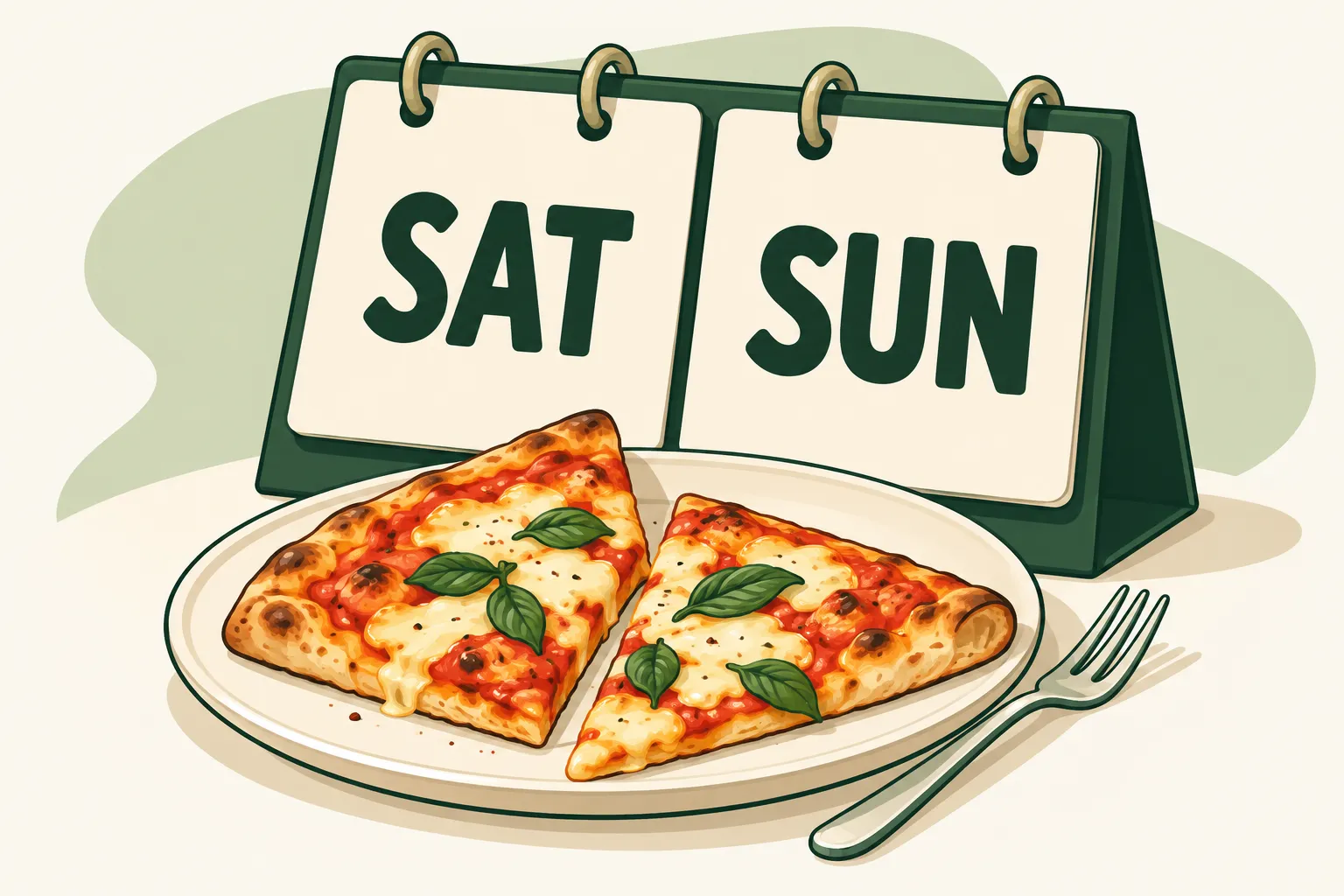
Imagine you usually arrive home hungry on Friday, spend Saturday afternoon out and have a restaurant booking that evening. On Sunday, you tend to keep eating from snacks left on the table.
Here’s a made-up example to show the decisions. Change the meals and timings to fit your own weekend.
Friday: make dinner possible when you get home
Your first decision is what you’ll eat after work. Choose something you can realistically get ready then: leftovers, a familiar quick meal or a suitable ready meal.
A takeaway can also be a deliberate choice. Decide what you’d like to order and consider the portion, sides and drinks, rather than leaving the whole decision until you’re tired and hungry. If you’re comfortably full and there’s food left, save it for another meal if you can store it safely.4
The question to settle before Friday evening is simple: “What will dinner be, and will it be available?”
Saturday: plan the hours before the restaurant
Keep the dinner booking. Look at the gap before it.
If you’re leaving home after breakfast and won’t eat dinner until eight, where will lunch come from? Decide whether you’ll take food, buy it while you’re out or return home to eat. Choose something that fits your appetite, budget and dietary needs.
Have a look at the restaurant menu beforehand if that helps. Think about the whole order: the main, any sides, drinks and dessert. If the main already comes with a side, check before ordering another one. If you’d like dessert, include it in your plans rather than treating it as a reason to give up on the evening.
You don’t need a fixed rule about which course you’re allowed. Decide what you want to enjoy, pay attention to the amounts and notice when you’re comfortably full.4
Suppose the booking moves later. You can plan for that too: “If dinner is delayed and I’m hungry, I’ll have something to eat rather than waiting until I’m ravenous.” If delays are common, bring a familiar snack or decide where you could buy one.
Sunday: decide what follows the meal out
If you ate more than intended on Saturday, return to your usual meals. You don’t need to skip food or add a workout to make up for dinner. NIDDK recommends returning to your healthy eating plan after eating more than planned.7
For the snacks on the table, try serving what you want and putting the rest away. If you’re hungry for a meal, make a meal. The point is to notice the decision rather than keep picking while doing something else.
Then note one thing for next time. Perhaps lunch worked well, but the restaurant delay was difficult. That gives you something specific to plan around on another evening out.
You don’t need to adopt every part of this example. Choose the part that matches your weekend.
Check whether the change helped
After trying your adjustment, ask two separate questions:
- Was it practical? Was lunch available? Did the backup dinner take more work than you could manage? Were you still uncomfortably hungry?
- Is the overall pattern supporting your goal? An easier evening is useful. It doesn’t, on its own, tell you whether you’re eating less energy than your body uses. Look at how you’re eating across the week and how your progress is going over time.
Keep the change that helped. Rethink one that turned out to be too expensive, inconvenient or unsatisfying. Reviewing and adjusting your goals is part of the process.6
If you use a scale, a single Monday reading can’t tell you how much body fat changed. Water can affect short-term readings too.3 Our guide to reviewing a flat week on the scale explains how to compare your records more usefully.
If you’re rebuilding a routine after weight regain, use what you know from the previous attempt. Which weekend habits were workable, and which depended on time or support you no longer have? You can keep useful parts while planning for your circumstances now.
When the problem needs more support
If you regularly feel unable to control your eating, or try to make up for eating by vomiting, misusing laxatives, fasting or exercising excessively, speak with a healthcare professional. Eating disorders can occur at any body weight.8 These experiences deserve proper support, rather than another set of weekend rules.
You can also ask a registered dietitian for help if your meals leave you persistently hungry or you’re unsure whether your eating plan meets your needs. Follow any eating plan you have for a medical condition with your healthcare team.
Make one decision before the next weekend
Think of the first point where your last weekend became difficult. Choose one decision to make before that point arrives: arrange Saturday lunch, have Friday dinner ready to use, or decide what you’ll eat after a meal out.
Write it as something you can act on: “Before I leave on Saturday, I’ll decide where lunch is coming from.”
Try it, notice what happens and adjust. Your weekend can look different from your working week while still being part of the same plan.
Scope: General education for adults for whom weight loss is appropriate. This isn’t a weight-loss plan for children, people who are underweight, or during pregnancy or breastfeeding. Eating-disorder care and medical dietary needs require tailored support.
Sources
Footnotes
-
National Institute of Diabetes and Digestive and Kidney Diseases. “Changing Your Habits for Better Health.” Last reviewed November 2020. Read the guidance. ↩
-
NHS. “Overweight and obesity in adults.” Last reviewed 29 April 2026. Read the guidance. ↩
-
Racette SB, Weiss EP, Schechtman KB, et al. “Influence of Weekend Lifestyle Patterns on Body Weight.” Obesity. 2008;16(8):1826–1830. Read the study. Small study of adults aged 50–60; weekend eating was not randomly assigned. ↩ ↩2
-
NHS. “Tips to help you lose weight.” Last reviewed 17 March 2023. Read the guidance. ↩ ↩2 ↩3
-
NHS. “Calories in alcohol.” Last reviewed 12 June 2023. Read the guidance. ↩
-
Centers for Disease Control and Prevention. “Steps for Losing Weight.” Dated 17 January 2025. Read the guidance. ↩ ↩2
-
National Institute of Diabetes and Digestive and Kidney Diseases. “Eating & Physical Activity to Lose or Maintain Weight.” Last reviewed May 2023. Read the guidance. ↩
-
National Institute of Mental Health. “Eating Disorders: What You Need to Know.” Revised 2024. Read the guidance. ↩