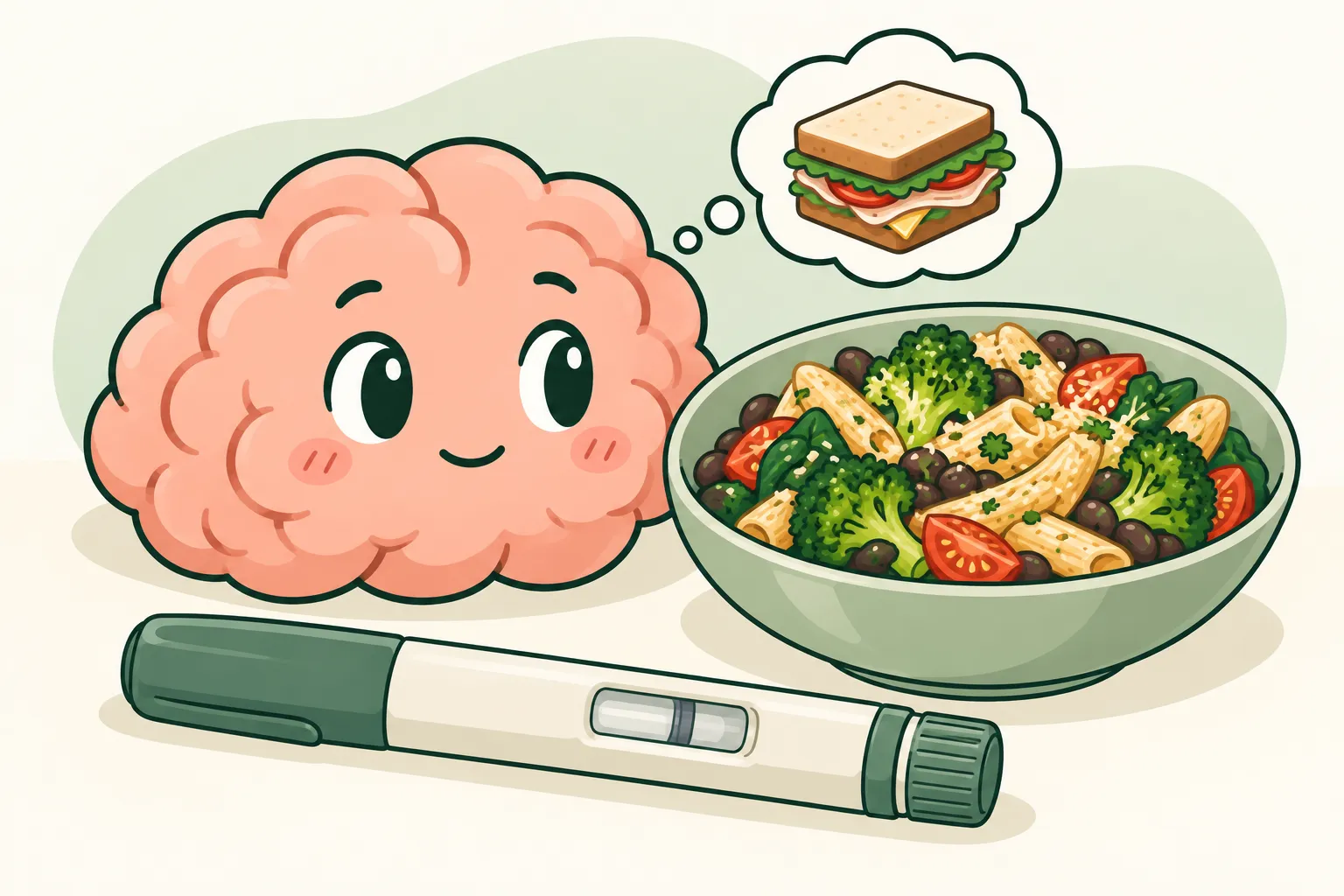
A GLP-1 can change how hungry you feel and when a meal feels like enough. Still wanting lunch doesn't, on its own, tell you whether treatment is helping.
Imagine finishing lunch. You could eat a bit more, and part of you still wants to. Stopping takes a decision. On another day, you’ve had enough and getting more barely crosses your mind.
GLP-1 appetite suppression works by changing the signals that help regulate hunger and satisfaction after eating. Medicines such as semaglutide activate GLP-1 receptors, including those in parts of the brain involved in appetite. That can make you feel less hungry and more satisfied with a meal.12
When someone says their appetite has changed, they might mean they’re happy with a smaller serving, less interested in a snack, or thinking about food less often. They don’t necessarily mean they’ve stopped wanting food altogether.
How GLP-1 medicines affect appetite
Your gut makes a hormone called GLP-1, short for glucagon-like peptide-1. It helps your body respond to food, including managing blood sugar and appetite.3
Cells receive its signals through receptors. A medicine such as semaglutide activates those receptors too. That’s what the medical name GLP-1 receptor agonist means: an agonist activates a receptor.1
Some of those receptors are in parts of your brain that help regulate appetite. Semaglutide can reduce how much you eat, and its prescribing information points to these appetite effects as the likely reason.1
Think back to that lunch. Feeling less interested in more food can make stopping feel different from wanting more and repeatedly deciding against it.
If you’d like the wider explanation, including digestion and blood sugar, see how GLP-1s actually work.
Less hunger, more fullness and fewer cravings
You can be ready for lunch without craving anything in particular. You can also want chocolate even though you’ve just eaten. Both get described as appetite, but they aren’t quite the same feeling.
Here’s what the different words mean:
| Term | What it describes | An everyday example |
|---|---|---|
| Hunger | The feeling that you want or need to eat. | “I’m ready for lunch.” |
| Fullness | How full you feel after eating. | “That meal feels like enough.” |
| Satiety | The satisfaction that helps keep hunger away after a meal. | “I’m comfortable waiting until later to eat again.” |
| Craving | A desire for a particular food. | “I’d really like some chocolate.” |
You don’t need to tick every box to describe a change. The examples help put words to what you notice; they aren’t a treatment checklist.
Researchers have looked at these feelings separately. In one small randomized semaglutide trial, adults with obesity reported less hunger, fewer cravings and better control over eating.3
Another randomized trial followed 72 adults with obesity for 20 weeks. Those taking semaglutide felt fuller and stayed satisfied longer, with less hunger and fewer cravings than those taking a placebo. They also ate less at a test lunch where they could choose how much to have.2
This was a small study funded by the manufacturer. It can’t predict how much you’ll eat or how every GLP-1 medicine will feel.2
Does GLP-1 appetite suppression reduce food noise?
Looking forward to dinner is one thing. Having thoughts about food keep interrupting whatever you’re trying to do is another.
People use “food noise” to describe those persistent, intrusive thoughts when they get in the way of daily life.4 Enjoying a meal or wanting a favourite snack doesn’t, by itself, mean there’s a problem.
Reports of quieter food thoughts during GLP-1 treatment helped bring attention to the term. But researchers are still working on how to measure the experience. In 2025, they published a study testing a Food Noise Questionnaire. It didn’t test a medicine, and people taking weight-loss medicines were excluded. We can’t use it to say that GLP-1 treatment eliminates food noise.4
The semaglutide trials did find changes in hunger, cravings and control of eating.23 Asking about those feelings isn’t quite the same as measuring how often food thoughts interrupt your day.
If you notice “I think about snacks less often”, that’s something you can tell your prescriber. It helps describe your experience. It isn’t a test that everyone needs to pass for treatment to be helping.
Is it just food staying in your stomach longer?
Food can move from your stomach into your small intestine more slowly with these medicines. You’ll see that called delayed gastric emptying. How much it changes depends on the medicine and how long you’ve been taking it. Tirzepatide’s label, for example, says the delay is greatest after the first dose and gets smaller over time.5
But slowing that movement doesn’t explain every appetite change. At the end of the 20-week semaglutide study, people still had appetite changes even though the researchers didn’t detect a delay in stomach emptying. They checked it indirectly, by measuring paracetamol absorption, so the test couldn’t fully show how a whole meal moved through the stomach.2
You’ll often hear semaglutide and tirzepatide discussed together. There is a difference: tirzepatide activates both GIP and GLP-1 receptors, while semaglutide activates GLP-1 receptors. They aren’t interchangeable medicines.15
Why you can still feel hungry on a GLP-1
If you’re still looking forward to breakfast, you might wonder whether the medicine is doing anything. But wanting a meal, or something sweet afterwards, isn’t enough on its own to answer that question.
The studies looked at changes in hunger and eating. They didn’t define success as never feeling hungry again.23 Less appetite doesn’t have to mean no appetite.
There’s no deadline in this research that you can use to judge when you personally should feel a change. In the 20-week study, the dose went up gradually and appetite was assessed at the end. It wasn’t designed to find out when each person first noticed a difference.2
If you’re unsure, take what you’ve noticed to your prescriber. “I’m hungry before meals, but satisfied sooner” tells them more than “I still have an appetite.” They need to consider that alongside your symptoms, whether you’re getting enough nourishment and how treatment is going overall. Don’t change the dose yourself.6
Nausea is different from feeling satisfied
Feeling comfortably finished with a meal is different from leaving it because you feel too sick to eat. If you’re comparing your experience with someone else’s, keep that difference in mind.
Nausea, vomiting, diarrhoea and constipation can happen with semaglutide. Researchers combined results from weight-management trials and found that people lost weight both with and without these stomach and bowel side effects. The symptoms explained little of the extra weight loss seen with treatment. This was an exploratory look at the results, rather than a trial set up to separate every cause of weight change.7
You don’t need to feel nauseated to show that treatment is helping, and feeling worse doesn’t mean you’re getting better results.
Seek urgent medical help for severe, persistent abdominal pain. Repeated vomiting or being unable to keep fluids down also needs prompt medical attention because dehydration can become serious.1
What to discuss with your prescriber
You don’t have to arrive at an appointment with the right medical words. Start with what happens around your ordinary meals:
- When do you feel hungry, and does a meal satisfy you?
- Have cravings or repeated food thoughts changed?
- Can you eat and drink adequately, or do symptoms get in the way?
Ask: “How should we assess whether this treatment is helping me, while making sure I can eat adequately?”
That gives you and your prescriber something specific to talk through. Eating as little as possible doesn’t need to become your measure of success.
If you’ve heard other claims about what treatment should feel like, our guide to GLP-1 weight-loss myths looks at some of those expectations.
This article explains appetite effects in adults. It doesn’t assess whether a medicine is suitable for you or provide instructions for starting, stopping or changing treatment.
Sources
Sources checked 13 October 2026.
Footnotes
-
Novo Nordisk. Wegovy: US prescribing information. DailyMed; revised June 2026. Sections 5 and 12. Product-specific information, not a description of every GLP-1 medicine. ↩ ↩2 ↩3 ↩4 ↩5
-
Friedrichsen M, et al. The effect of semaglutide 2.4 mg once weekly on energy intake, appetite, control of eating, and gastric emptying in adults with obesity. Diabetes, Obesity and Metabolism. 2021;23:754–762. Manufacturer-funded randomized trial in 72 adults with obesity. ↩ ↩2 ↩3 ↩4 ↩5 ↩6 ↩7
-
Blundell J, et al. Effects of once-weekly semaglutide on appetite, energy intake, control of eating, food preference and body weight in subjects with obesity. Diabetes, Obesity and Metabolism. 2017;19:1242–1251. Manufacturer-funded randomized crossover trial in 30 adults with obesity. ↩ ↩2 ↩3 ↩4
-
Diktas HE, et al. Development and validation of the Food Noise Questionnaire. Obesity. 2025;33:289–297. Questionnaire validation, not a treatment-effect trial. ↩ ↩2
-
Eli Lilly. Zepbound: US prescribing information. DailyMed. Sections 12.1 and 12.2. ↩ ↩2
-
National Institute of Diabetes and Digestive and Kidney Diseases. Prescription Medications to Treat Overweight & Obesity. General treatment guidance; medicine suitability and monitoring require individual assessment. ↩
-
Wharton S, et al. Gastrointestinal tolerability of once-weekly semaglutide 2.4 mg in adults with overweight or obesity, and the relationship between gastrointestinal adverse events and weight loss. Diabetes, Obesity and Metabolism. 2022;24:94–105. Manufacturer-funded pooled and exploratory analyses of the STEP trials. ↩