The equation is real. The mistake is treating it as a complete explanation of human behavior.
The equation is real. The mistake is treating it as a complete explanation of human behavior.
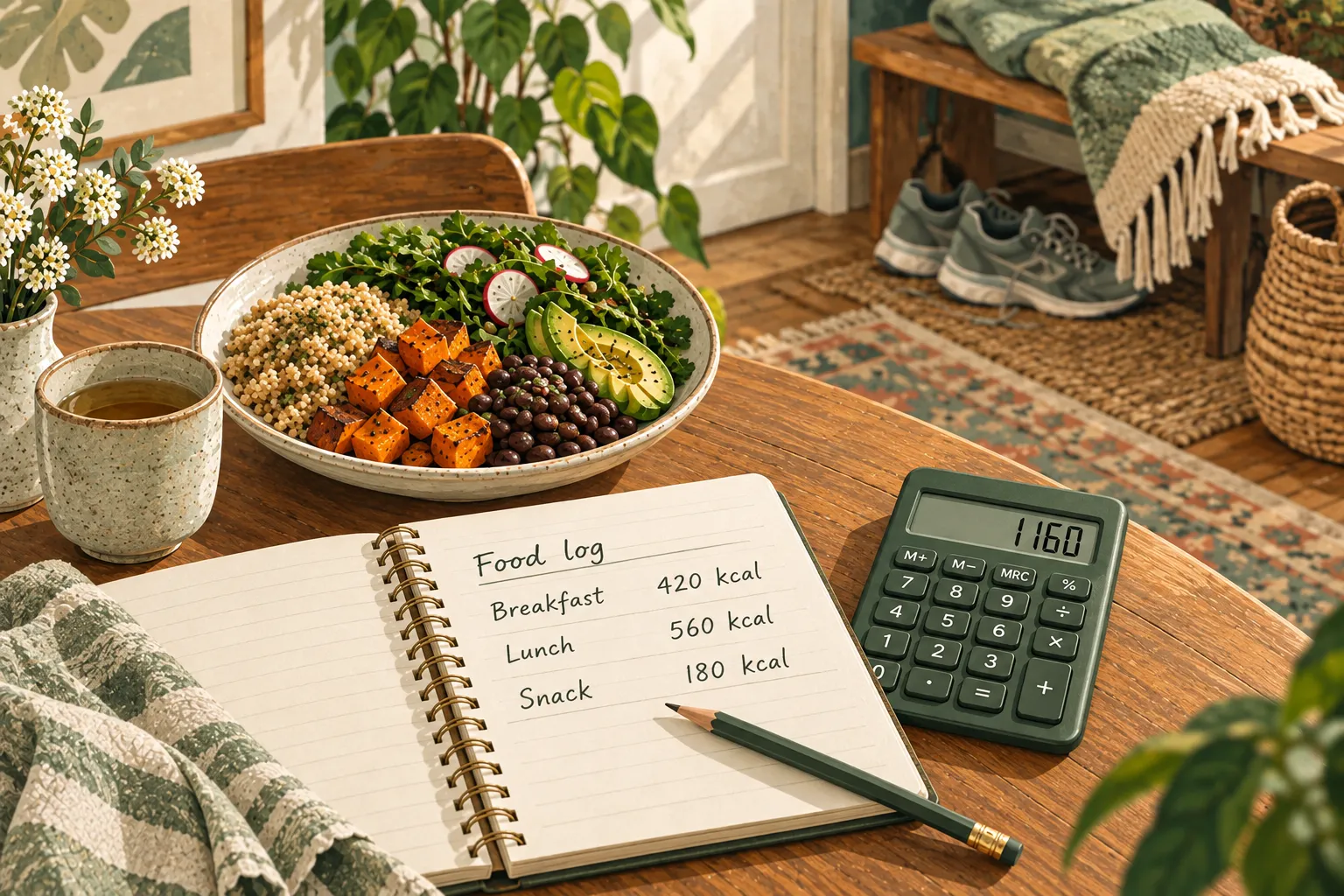
Imagine standing in the kitchen after dinner. You have eaten what you planned to eat. You know your calorie target. You know the snack you are considering will take you past it.
There is no missing arithmetic here. You do not need someone to explain subtraction again.
What needs explaining is why you want more food—and what would make that situation easier to manage next time.
“Calories in, calories out,” often shortened to CICO, describes energy balance. When the body uses more energy than it gets from food and drink over time, it draws on stored energy. That principle does not disappear because weight loss is difficult.1
The danger is not the equation. It is treating the equation as though it makes the behavior simple.
Between a calorie target and reaching for another snack is a body responding to hunger signals, food, sleep, and its surroundings. Understanding those responses is part of understanding energy balance—not an argument against it.234
A calorie total tells you how much, not why
Consider two different questions:
“How much energy did I eat today?”
“What made me want to keep eating?”
A calorie log can help answer the first. It cannot, on its own, answer the second.
Imagine someone repeatedly eating more than intended in the evening. Their record might accurately show where the extra calories came from. But “the snacks added up” still leaves the useful questions unanswered. Were they hungry before dinner? Was dinner satisfying? Were they exhausted? Was the food simply there while they did something else?
Those are questions to investigate, not explanations to assume.
It also helps to separate energy balance, a biological principle, from calorie counting, a way of recording food intake. Neither requires believing that changing intake is effortless, that food quality is irrelevant, or that everyone experiences the same appetite.
The problem begins when a useful observation—“your usual intake needs to change”—is presented as the entire solution.
What happens between the number and the snack?
Your brain does not receive a notification when you reach the target in your app. It receives signals from your body.
One example is ghrelin, a hormone produced mainly in the stomach that can stimulate hunger. Other signals, including the gut hormones PYY and GLP-1, participate in reducing appetite after eating. These chemical messages interact with brain systems involved in eating and food reward.34
This is not simply a distinction between “real physical hunger” and “wanting something tasty.” Biology can influence how appealing that tasty thing becomes.
In a small human experiment, researchers found that giving ghrelin to participants who had eaten breakfast increased the appeal of high-energy food pictures and altered activity in brain regions involved in evaluating food. The experiment demonstrated changes in food appeal and brain responses; it did not show a significant increase in subsequent food intake from ghrelin under those conditions.3
Other researchers found that administering PYY and GLP-1 together to fasting participants reduced their subsequent food intake and changed brain responses to food cues, resembling some effects of eating a meal.4
The important point is not that you need to memorize hormone names. It is that how strongly you want food is not determined only by how firmly you decided to eat less.
That does not mean every craving is a hormonal problem. It means a calorie target is only one piece of information in a much larger process.
Losing weight can change the appetite you are managing
There is another complication: the process of losing weight can affect the signals influencing what happens next.
In a study published in the New England Journal of Medicine, adults with overweight or obesity followed a prescribed very-low-energy weight-loss program. After the initial loss, researchers measured changes in several appetite-related hormones alongside increased hunger. A year later, several of those changes and the increase in hunger were still present compared with the participants’ starting measurements.5
This was a small study of a specific, restrictive intervention. It does not establish how every person will respond to a more moderate approach, and it does not mean weight regain is inevitable.5
It does show why “you managed this intake before, so just keep doing it” can miss something important. The appetite someone experiences after losing weight may not be the appetite they experienced at the beginning.
A workable plan needs room for that possibility—not an assumption that difficulty proves a lack of commitment.
Food choices can influence the amount you eat
Food is not just a number that enters the equation. The food available can influence what that number becomes.
In a controlled study at the US National Institutes of Health, 20 adults lived at a research facility and ate an ultra-processed diet and an unprocessed diet for two weeks each, in randomized order. They could eat as much or as little as they wanted. On the ultra-processed diet, participants ate roughly 500 more calories per day on average.6
That does not prove every ultra-processed food causes overeating. The diets differed in several respects, including the energy density of their solid foods and how quickly participants ate them, so the experiment did not isolate processing itself as the sole explanation.6
But consider what the result means for the advice.
“The participants ate more calories” describes what happened. It leaves out the fact that changing the food conditions changed their intake.
The calories still counted. What people were offered helped determine how many they consumed.
Sleep and circumstances belong in the explanation
A calorie target also does not account for the night you had before trying to follow it.
In a randomized trial of 80 adults with overweight who habitually slept less than 6.5 hours, a two-week sleep-extension intervention reduced estimated energy intake relative to the control group. The between-group difference in change was about 270 calories per day; participants were not prescribed a weight-loss diet.7
This is not a promise that sleeping longer will subtract a particular number of calories from your day. It was a short study in a selected population, and the longer-term effects remain uncertain.7
It is evidence that changing something outside a food plan can change eating behavior.
Practical circumstances matter too. Access to affordable food, facilities to prepare it, and opportunities for activity can make weight-management choices easier or harder. Health conditions and some medicines can also affect weight through appetite or energy use.2
None of this makes planning pointless. It makes “just choose differently” an incomplete answer when the conditions shaping that choice have not been considered.
“Calories out” is not a permanently fixed number
The other side of the equation changes as well.
As body weight and composition change, so does the energy needed to maintain the body and move it around. This is one reason a fixed reduction in food intake does not produce the same amount of weight loss indefinitely. Research modeling human weight change accounts for these moving parts rather than treating the body as a static calculation.1
There is also a difference between a calculated deficit and an actual deficit. A target based on estimated energy needs is not a direct measurement of your body’s energy balance.
And changes on the scale include water, not only changes in energy-containing tissue. One weigh-in cannot tell you precisely how much body fat you gained or lost.1
The lesson is not that numbers are useless. It is that their meaning depends on what was measured, what was estimated, and what has changed.
Where oversimplification becomes harmful
Here is the risk in treating weight loss as nothing more than arithmetic: every difficulty can start to look like evidence that the person is the problem.
Hungry? Ignore it. Struggling to follow the plan? Be stricter. Progress different from the prediction? Cut more.
That is not a thoughtful application of energy balance. It is a refusal to investigate why the plan is difficult to use.
A particularly unhelpful leap is to assume that because a lower intake would create a larger deficit on paper, a lower target must be a better plan. That conclusion skips the question of whether the person can eat adequately and follow it in ordinary life.
This criticism does not mean calorie counting is inherently harmful or that everyone should stop. A record can be useful without becoming a verdict on your character. The problem is using the record to end the investigation instead of beginning one.
Keep the information. Ask a better next question.
You do not have to choose between “calories are everything” and “calories do not matter.”
Start with one recurring situation in which your eating differs from what you intended. Briefly note what happened before it: your previous meal, hunger, sleep, what food was available, and what else was happening. Look for a pattern rather than trying to diagnose yourself from one evening. Reviewing obstacles and planning around them are practical approaches described in NIDDK’s behavior-change guidance.8
Then choose a change that addresses the situation you actually found.
For example, suppose the pattern is arriving home very hungry when dinner will not be ready for another hour. A planned afternoon snack or an earlier, easier dinner is an option to test. Account for it as part of your overall eating pattern—not as a supposedly calorie-free addition.
Or suppose dinner keeps becoming an unplanned order because the meal you intended to cook takes too long. Keep a quicker backup you enjoy and can afford. That is a different problem from not knowing how many calories dinner contains.
These are planning examples, not guarantees or a prescribed diet. After trying a change, ask whether it was available when needed, whether it made the situation easier, and whether the overall pattern still fits your goal. Keep what helps; revise what does not.8
You do not need to identify a hormone to make that review useful. Nor do you need to suppress hunger to prove that you understand weight loss.
When eating involves frequent loss of control, severe restriction, or intense distress, seek qualified support rather than responding with a stricter target. A calorie equation cannot assess or treat those problems.9
The next time you reach for an extra snack, the calories are information. So is what happened before you reached for it. A useful weight-loss plan pays attention to both.
Sources
Footnotes
-
Hall KD, et al. Quantification of the effect of energy imbalance on bodyweight. The Lancet. 2011;378:826–837. Read the research record and access the manuscript. ↩ ↩2 ↩3
-
National Institute of Diabetes and Digestive and Kidney Diseases (NIDDK). Factors Affecting Weight & Health. Last reviewed May 2023. Read the guidance. ↩ ↩2
-
Goldstone AP, et al. Ghrelin mimics fasting to enhance human hedonic, orbitofrontal cortex, and hippocampal responses to food. American Journal of Clinical Nutrition. 2014;99(6):1319–1330. Read the study. ↩ ↩2 ↩3
-
De Silva A, et al. The gut hormones PYY 3–36 and GLP-1 7–36 amide reduce food intake and modulate brain activity in appetite centers in humans. Cell Metabolism. 2011;14(5):700–706. Read the study abstract and figure descriptions. ↩ ↩2 ↩3
-
Sumithran P, et al. Long-term persistence of hormonal adaptations to weight loss. New England Journal of Medicine. 2011;365:1597–1604. Read the authors’ institutional abstract. ↩ ↩2
-
Hall KD, et al. Ultra-processed diets cause excess calorie intake and weight gain: An inpatient randomized controlled trial of ad libitum food intake. Cell Metabolism. 2019;30(1):67–77.e3. Read the study. ↩ ↩2
-
Tasali E, et al. Effect of Sleep Extension on Objectively Assessed Energy Intake Among Adults With Overweight in Real-life Settings: A Randomized Clinical Trial. JAMA Internal Medicine. 2022;182(4):365–374. Read the study. ↩ ↩2
-
NIDDK. Changing Your Habits for Better Health. Last reviewed November 2020. Read the guidance. ↩ ↩2
-
National Institute of Mental Health (NIMH). Eating Disorders: What You Need to Know. Revised 2024. Read the guidance. ↩