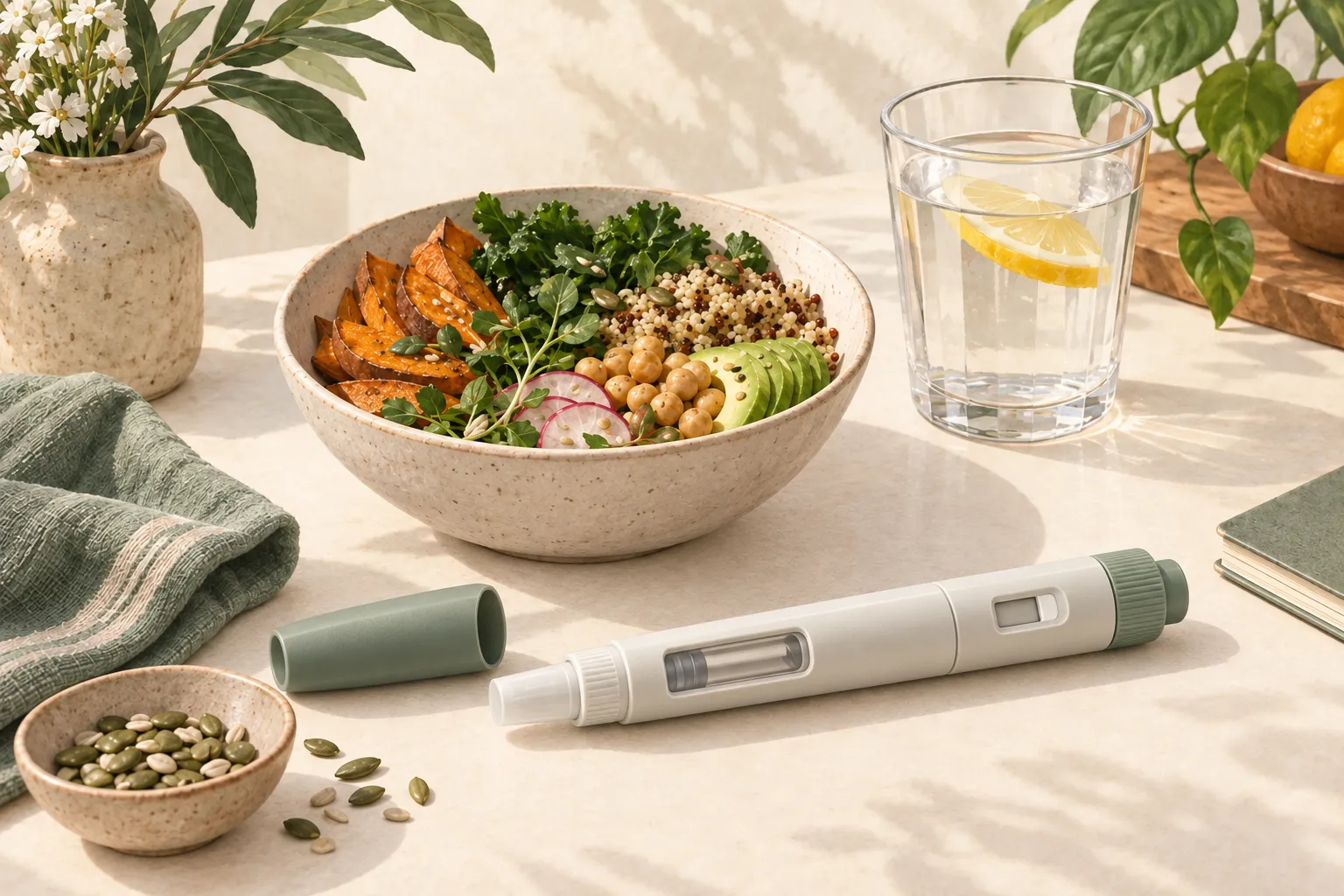
GLP-1 medicines help with weight loss largely by changing the signals that regulate appetite and food intake. They can make hunger less intense and eating less feel more satisfying. They also affect blood sugar and how quickly food leaves the stomach—but slower digestion is only part of the explanation.
GLP-1 medicines help with weight loss largely by changing the signals that regulate appetite and food intake. They can make hunger less intense and eating less feel more satisfying. They also affect blood sugar and how quickly food leaves the stomach—but slower digestion is only part of the explanation.123
The useful distinction is this: they do not replace energy balance. They change some of the biology that influences it.24
Understanding that connection helps explain both why these medicines can work and why their effects are more complicated than “the injection makes you eat less.”
Your body already makes GLP-1
GLP-1 stands for glucagon-like peptide-1. It is a hormone your gut releases in response to eating: one of the chemical messages that helps coordinate what happens after a meal.1
That message has several destinations. It helps the pancreas respond to rising blood sugar, influences appetite through the brain, and slows the movement of food from the stomach into the small intestine. These are connected responses to food arriving, not separate tricks invented by a weight-loss medicine.1
Natural GLP-1 is rapidly broken down by an enzyme called DPP-4. Its signal is short-lived. The medicines are designed to activate the same receptor while lasting much longer.12
A receptor is a structure on a cell that responds to a particular signal. An agonist activates that receptor. “GLP-1 receptor agonist” therefore describes what the medicine does—not simply what it contains.2
The medicines make the signal last longer
Semaglutide, for example, is modified to resist breakdown and bind to albumin, a protein in the blood. These changes help it stay in the body. Its half-life—the time for its concentration to fall by about half—is approximately one week, supporting its use in weekly injections.2
This is not simply a brief after-meal signal repeated once. It is longer-lasting receptor stimulation.
There is also an important naming distinction. Semaglutide activates GLP-1 receptors. Tirzepatide, another medicine commonly grouped under the “GLP-1” label, activates both GLP-1 and GIP receptors.25
GIP—glucose-dependent insulinotropic polypeptide—is another gut hormone involved in the insulin response to food. Tirzepatide is therefore a dual-receptor agonist, rather than a GLP-1-only medicine. That describes its mechanism; it does not mean “twice the effect” or make the medicines interchangeable.56
For weight loss, appetite is a major part of the story
GLP-1 receptors are present in brain regions involved in regulating appetite. The medicines influence this system; their effect is not confined to keeping food in the stomach.25
Human research shows what that can mean in practice. In a randomized trial involving 72 adults with obesity, participants receiving semaglutide for 20 weeks reported less hunger, greater fullness, and fewer or weaker food cravings than those receiving placebo. At a freely chosen test lunch, the semaglutide group consumed an average of 35% less energy.3
That figure describes one study meal, not a promised reduction in everyone’s daily intake.
For an illustrative example, imagine finishing dinner and considering another serving. Eating less could mean still wanting that serving intensely and repeatedly deciding against it. A change in appetite could instead mean feeling satisfied with the meal already eaten.
Those are different experiences, even when the amount left on the plate looks identical. The example is not a prediction for every person; it illustrates the difference between resisting hunger and experiencing less of it.
Slower stomach emptying matters—but it is not the whole mechanism
These medicines can delay gastric emptying: the movement of a meal out of the stomach. However, the size and persistence of that effect vary. Tirzepatide’s prescribing information states that the delay is greatest after the first dose and diminishes over time.5
In the 20-week semaglutide study, researchers still found appetite and food-intake effects without detecting delayed stomach emptying at the final assessment. There is an important limitation: they used an indirect paracetamol-absorption test, not a direct measurement of the whole meal leaving the stomach. The result does not establish that semaglutide never delays emptying.3
The practical conclusion is narrower: “food stays in your stomach longer” is an incomplete explanation of how these medicines work.
Delayed emptying still matters medically. Tell the team caring for you before a procedure involving anaesthesia or deep sedation that you take one of these medicines. They need that information to plan safely; do not invent your own medication-withholding schedule.5
They also change how the pancreas handles blood sugar
The pancreas produces both insulin and glucagon. Insulin helps lower blood glucose; glucagon helps raise it, including by telling the liver to release glucose.7
GLP-1 receptor activation helps increase insulin secretion and reduce glucagon secretion in a glucose-dependent way. In plain language, these effects respond to the glucose level rather than simply forcing the same amount of insulin out regardless of circumstances.25
That does not mean low blood sugar is impossible. The risk is particularly important when these medicines are used with insulin or medicines such as sulfonylureas. Medication combinations need a prescriber’s attention.5
Blood-sugar regulation is one part of their action. Appetite and food-intake regulation explain another important part; the mechanism is broader than a single change in insulin.12
So how does that lead to fat loss?
Body fat is an energy store. When energy intake remains below energy expenditure over time, the body draws on stored energy. But the factors influencing that balance include biology, environment, health, and behaviour—not just a conscious decision about portions.4
GLP-1-based treatment can change the intake side by making it easier to eat less. That can help create an energy deficit without the same degree of hunger someone might otherwise experience. This connects the observed appetite effects to energy balance; it is not a claim that food intake is the medicines’ only physiological effect.234
There are two unhelpful extremes here. “Calories no longer matter” misunderstands energy balance. “It is just eating less, so the medicine does nothing meaningful” overlooks the biological change that can make eating less more manageable.34
Explaining the mechanism does not diminish the treatment. Changing a driver of eating is a meaningful intervention, not evidence that someone should have been able to produce the same result through willpower.
Nausea is a side effect, not the goal
Nausea, vomiting, diarrhoea, and constipation can occur. But feeling ill is not a necessary sign that treatment is working.8
A secondary analysis of semaglutide weight-management trials found that weight loss was largely independent of gastrointestinal side effects. Participants without those side effects also lost weight. Because this was an exploratory analysis rather than a trial specifically designed to isolate nausea, it should not be treated as a perfect measurement of every mechanism. It does, however, argue against “people lose weight mainly because they feel sick.”8
The distinction matters when judging your own experience. The absence of nausea does not establish that a medicine is ineffective. Conversely, severe symptoms should not be treated as evidence of better results.8
Seek urgent medical help for severe, persistent abdominal pain. Repeated vomiting or being unable to keep fluids down also needs prompt assessment because dehydration can become serious.2
The effects are not necessarily a permanent reset
A medicine can help while it is being taken without permanently changing the system it acts on.
In the STEP 4 trial, adults who had completed an initial period of semaglutide treatment were randomized either to continue it or switch to placebo. Both groups continued lifestyle support. Over the following 48 weeks, those switched to placebo regained weight on average, while those continuing semaglutide lost more.9
The trial included people who had reached and tolerated the study dose. It does not tell us that everyone will regain the same amount, or that every person must use a particular medicine forever.9
It does show why maintenance deserves a plan rather than an assumption that reaching a target weight permanently switches off the original difficulty. Decisions about continuing or ending treatment belong in a discussion of benefits, side effects, circumstances, and alternatives with the prescriber.910
What to take from this
GLP-1 medicines are better understood as treatments that affect appetite and metabolic signalling than as injections that simply hold food in the stomach. That distinction helps make sense of their effects without treating weight loss as either magic or a character test.125
For someone considering or using treatment, a useful question for the prescriber is:
“What changes should we monitor in my appetite, ability to eat adequately, symptoms, and weight—and what is our longer-term plan?”
That conversation is more useful than trying to judge treatment solely by how little you can eat.
This article explains mechanisms. It is not a suitability assessment or instructions for starting, stopping, or changing treatment.
Sources
Sources checked 16 September 2026.
Footnotes
-
Society for Endocrinology. Glucagon-like peptide 1. Reviewed July 2021. Used for established hormone physiology, not current medicine availability. ↩ ↩2 ↩3 ↩4 ↩5 ↩6
-
Novo Nordisk. Wegovy: US prescribing information. DailyMed; revised June 2026. Sections 5, 11, and 12. ↩ ↩2 ↩3 ↩4 ↩5 ↩6 ↩7 ↩8 ↩9 ↩10 ↩11 ↩12
-
Friedrichsen M, et al. The effect of semaglutide 2.4 mg once weekly on energy intake, appetite, control of eating, and gastric emptying in adults with obesity. Diabetes, Obesity and Metabolism. 2021;23:754–762. doi:10.1111/dom.14280. ↩ ↩2 ↩3 ↩4 ↩5
-
National Institute of Diabetes and Digestive and Kidney Diseases. Factors Affecting Weight & Health. Reviewed May 2023. ↩ ↩2 ↩3 ↩4
-
Eli Lilly. Zepbound: US prescribing information. DailyMed; revised August 2026. Sections 5 and 12. ↩ ↩2 ↩3 ↩4 ↩5 ↩6 ↩7 ↩8
-
Society for Endocrinology. Glucose-dependent insulinotropic peptide. Reviewed August 2024. ↩
-
Society for Endocrinology. Glucagon. Reviewed September 2021. ↩
-
Wharton S, et al. Gastrointestinal tolerability of once-weekly semaglutide 2.4 mg in adults with overweight or obesity, and the relationship between gastrointestinal adverse events and weight loss. Diabetes, Obesity and Metabolism. 2022;24:94–105. doi:10.1111/dom.14551. ↩ ↩2 ↩3
-
Rubino D, et al. Effect of Continued Weekly Subcutaneous Semaglutide vs Placebo on Weight Loss Maintenance in Adults With Overweight or Obesity: The STEP 4 Randomized Clinical Trial. JAMA. 2021;325:1414–1425. ↩ ↩2 ↩3
-
National Institute of Diabetes and Digestive and Kidney Diseases. Prescription Medications to Treat Overweight & Obesity. Reviewed June 2024. Used for general treatment planning, not current product-specific labelling. ↩